A proposal to Her Excellency Senator Oluremi Tinubu, CON, OON
First Lady of the Federal Republic of Nigeria · Chairperson, Renewed Hope Initiative
Twenty million Nigerians live within twenty-five kilometres of an international border. They are the first to meet whatever crosses into Nigeria, and the last to receive whatever Nigeria has to give.
Nigeria does not end at her borders. Nigeria begins there.
The people this is about
live in more than 2,000 border communities across 105 Local Government Areas and 21 States — approximately 14% of the population of this country. They have never been counted, community by community, even once.
For comparison
What this looks like on the ground
In Banki, she walks across the border into Cameroon to deliver her baby, because there is no functioning delivery room on the Nigerian side. Her child is Nigerian. No document in the world says so.
In Idiroko, she crosses into Benin Republic every morning to attend school. She comes home speaking a language her own mother does not speak, and singing another country's anthem before she sings ours.
In Sabon Birni, they cross into Niger Republic to fetch drinking water. They have not turned away from Nigeria. Nigeria has simply not yet arrived.
Illustrative of conditions documented across Nigeria's border communities.
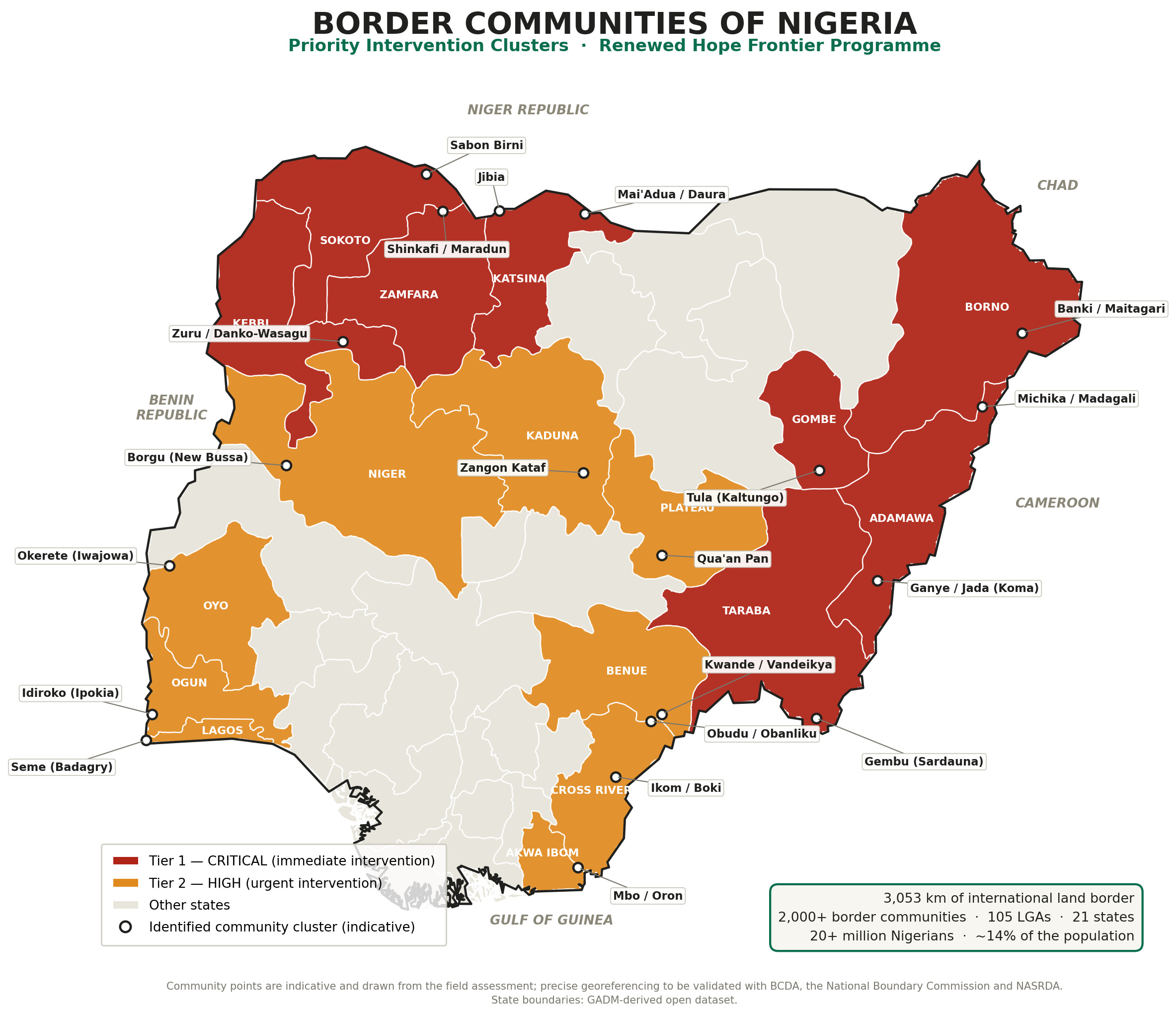
Where they are
Twenty-one sentinel communities, one in every border state. Select any point to see it.
Tier 1 requires immediate intervention; Tier 2, urgent intervention. Community points are indicative pending georeferencing in Phase 0 with the Border Communities Development Agency, the National Boundary Commission and NASRDA.
A family gives its loyalty to whoever gives it water.
In February 2026 the Senate Committee on States and Local Government Affairs warned that because facilities are not provided for border communities, those communities sometimes give their allegiance to neighbouring countries — crossing over for schooling, and in some cases simply to fetch water.
This is not disloyalty. It is arithmetic.
The problem is not the money
What has never existed is a map of where the need actually is.
appropriated for border community development in the current budget cycle
authoritative, georeferenced vulnerability scores for Nigeria's 2,000+ border communities
the cost of producing them, and a costed national plan, in six months
Without a register, allocation drifts toward wherever a request is loudest — not toward where the need is greatest.
The proposal
Two halves, and the first makes the second possible.
Build the Frontier Vulnerability Index and the National Frontier Register — the first authoritative, georeferenced, community-by-community measurement of vulnerability across all 2,000+ border communities.
Nigeria has never had one. Without it, every naira spent at the frontier is spent blind.
A costed, sequenced package delivered through five pillars — water, health, education, energy, livelihoods, identity, and the health coverage that keeps it all running.
Beginning with a 100-Day Frontier Compassion Sprint in one community in every border State.
A continuous corridor of maternal and child care along Nigeria's entire land frontier, so that no Nigerian woman has to leave Nigeria to deliver her baby. Every child born in a Renewed Hope Frontier community leaves the delivery point with two things: a healthy mother, and a Nigerian birth certificate.
Each community also receives a solar care booth — the escalation route that turns a health post staffed by a community health worker into a health post with a doctor behind it.
A solar borehole in every intervention community. A mini-grid for the clinic, school, market and water point. Classrooms rehabilitated, teachers deployed with a frontier allowance, school feeding, and accelerated learning for children returning from schooling across the border.
Agricultural inputs and dry-season irrigation. Women-led savings and loan associations. International border markets that convert informal cross-border trade into recorded, protected commerce. A dedicated youth track.
Mass birth registration and National Identification Number enrolment. Civic education in the local language. Restoration of the Nigerian curriculum. Community development committees with real standing and mandatory female and youth representation.
Every household enrolled into the NHIA's existing Vulnerable Group Fund through the national architecture — but only once the facility is equipped, staffed and accredited. Enrolment is not coverage: a card is worthless where the clinic has no water.
What always happens here
suspected cholera cases in Borno this year, with 39 deaths
case fatality rate in the outbreak Bauchi declared on 31 July
suspected diphtheria infections in one year, northern Nigeria
deaths in the meningitis outbreak across 23 states
Children under five are the age group most affected by cholera. The NCDC names the cause plainly: no potable water, no sanitation.
When an outbreak reaches a border community today
The treatment is rehydration in clean water. Without a water point, the cure requires the thing whose absence caused the disease.
Vaccines need 2–8°C. No power, no refrigerator, no cold chain — only a cold box with hours of life in it.
A campaign needs a denominator. No birth registration means coverage cannot be measured and defaulters cannot be traced.
With no health centre, patients are nursed at home by unprotected relatives, and household transmission does the rest.
Response teams travel by road. Where the road floods for months, tracing is done on foot — or not at all.
No network, no radio, no local-language channel. Rumour fills the vacuum, and refusal follows.
And before all six: you cannot respond to an outbreak you never detected. Surveillance begins when a clinician notifies the LGA — so where there is no clinic, there is no data at all.
No extra line item. Everything already in this Programme does one job on an ordinary day and a completely different job on the worst day.
| What we build | On an ordinary day | In an outbreak |
|---|---|---|
| Solar borehole | Ends the walk across the border for water | Interrupts cholera at source; supplies the clean water rehydration needs |
| Solar mini-grid | Lights the school and the delivery room | Runs the vaccine fridge — the cold chain that makes any campaign possible |
| Health centre | Antenatal care and childhood illness | Case management and isolation; a treatment centre a response team can use |
| Solar care booth | Puts a Nigerian doctor within reach of a village that has never had one | Remote verification and surge triage when the road is impassable |
| Birth registration | Gives a child legal existence | The denominator without which vaccination coverage cannot be measured |
| Access road | Market, school, referral | Carries the response team and the vaccines — in the rainy season, when outbreaks peak |
| Hope Ambassadors | Antenatal follow-up and WASH caretaking | Contact tracing and risk communication in the language the household speaks |
| The Frontier Line | Report a broken borehole | Risk communication — one message to every enrolled household, in their language |
| OutbreakVoice | Carries routine traffic that builds the baseline | Detection: illness reported by voice, clustered into a signal, escalated to the NCDC |
Nigeria will spend this money either way. The only question is whether it is spent before the outbreak, or after it.
The digital tool
One number, reachable from any handset in a border community. No smartphone, no data bundle, no app. It works on 2G, in six languages, and it is free on every network.
Report a broken borehole. Reach a health worker. Register a birth. Flag unusual illness. Every call becomes a public record — and every call is also a measurement, which is how the Frontier Vulnerability Index keeps itself current without a survey convoy.
A working demonstration runs in your browser. Nothing is installed and no data leaves the page.
Nigeria cannot put a doctor in two thousand border villages. It can put a doctor within reach of all of them.
A small, private, lockable room inside the health post compound, running off its own solar panel and battery — independent of a grid that does not reach and a generator nobody can fuel.
It also charges the community's phones. That is deliberate: a booth people use every day is a booth the community values and watches.
Bandwidth is what actually varies at the frontier, so the booth has three working modes: video where the link allows it, audio where it does not, and store & forward where there is no live link at all — photographs, blood pressure, temperature and oxygen saturation sent up, a doctor's reply back the same day.
A telemedicine design that only works on good broadband is a design that will never work here.
The Frontier Hope Ambassador opens the booth, takes the readings the doctor cannot take remotely, holds the camera, and makes sure the advice is followed afterwards.
The booth is not a substitute for the health worker. It is what finally gives the health worker somebody to call.
In an outbreak the same booth becomes the remote verification point — how a State epidemiologist examines a patient in a community the road cannot reach that week.
Sequencing
Frontier Assessment: the Vulnerability Index, 21 sentinel community assessments, the National Frontier Register, the public dashboard and the costed national plan
The 100-Day Frontier Compassion Sprint — 21 communities, one in every border State
Renewed Hope Frontier 250 — the 250 highest-need communities, plus the first six international border markets
National coverage of all 2,000+ border communities, blended with Federal, State and partner funding
Only Phase 0 is requested for immediate approval. Phase 1–3 figures are indicative planning estimates, to be replaced by field-validated unit costs in Phase 0.
The request
What it buys
A defensible national evidence base for 20 million citizens. The first authoritative register of Nigeria's frontier. A public dashboard the whole country can inspect. A costed plan that turns ₦50bn already appropriated into verified delivery. And recorded testimony from frontier mothers, teachers and elders.
The legacy
Every First Lady of Nigeria is remembered for one thing. Mother of the Frontier.
The First Lady who went to the very edge of the country, and brought twenty million Nigerians back into the picture.
The full proposal
The complete submission, as presented.